House at the End of the Street
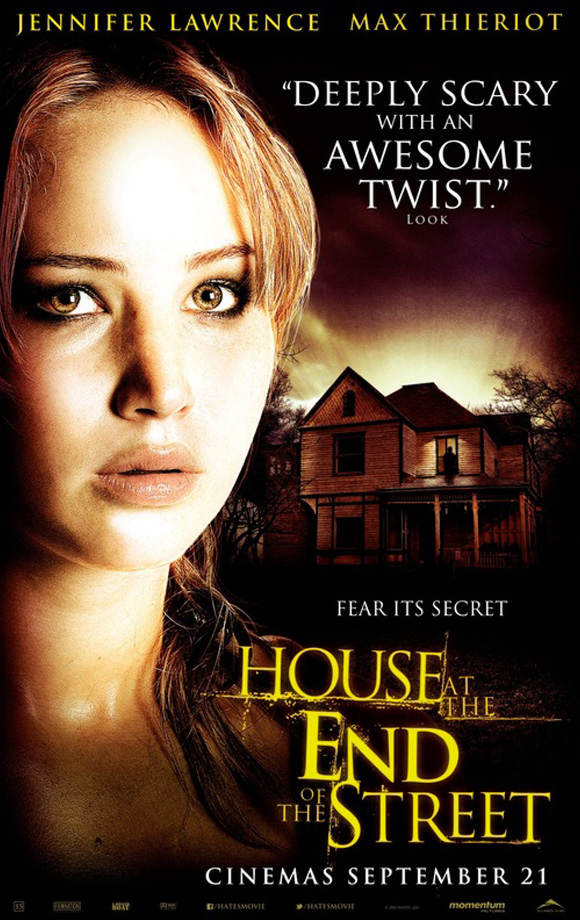
‘House at the End of the Street’ is a psychological thriller directed by Mark Tonderai that stars Jennifer Lawrence as Elissa, a teenager who moves with her recently divorced mother Sarah (Elisabeth Shue) to a small, upscale town. Their new home sits next to a house where, years earlier, a young girl named Carrie Anne reportedly murdered her parents and disappeared into the surrounding woods. The sole survivor, her brother Ryan (Max Thieriot), still lives in the house alone. As Elissa and Ryan develop a relationship, it becomes clear that the truth behind what happened in that house is far darker and more disturbing than anyone in the town realises.
Tonderai, who described the film as a “romantic thriller” rather than straight horror, deliberately steered the tone away from the typical genre convention. The film was shot in the 2-perf Techniscope format to produce a grainier, more textured image reminiscent of older horror films, and the director brought across several key collaborators from his previous feature ‘Hush’ such as composer Theo Green who I assisted. Tonderai’s approach was restrained and character-driven, drawing comparisons to Hitchcock in several interviews, and the film ultimately performed strongly at the box office – it reached number one in the US on its opening weekend and earning over $45 million from a budget of under $7 million.
About the score
The score for ‘House at the End of the Street’ was Theo’s second collaboration with Tonderai following ‘Hush’, which combined sonic, electronic, and orchestral composition in a way that established a strong creative shorthand between composer and director. For this project, the ambition was considerably larger as it has a bigger cast, a wider release through Relativity Media, so we needed the score to carry much of the film’s tension within the constraints of a PG-13 rating.
Rather than telegraphing every scare with predictable musical cues, I assisted Theo in building tension through layered electronic textures, low-frequency drones, and shifting tonal beds. One reviewer from Behind the Lens Online noted that the score served each scene with a subtlety that was “never intrusive, never telling” with the music taking its lead from the story rather than the other way around. This kind of restraint was deliberate and central to the vision of a film that unsettles through atmosphere rather than spectacle.
Working together
I’ve worked with Theo on various films before ‘House at the End of the Street’ as he’s been a mentor for me during my own career as a composer and I joined this project as additional music programmer, working alongside him to build and refine the electronic elements that formed the backbone of various cues throughout the score. My role involved programming and sculpting synthesised textures, ambient beds, rhythmic patterns and some melodic elements that Theo incorporated into the score in various forms.
This meant taking his creative direction for a given cue, whether that was a low, pulsing throb beneath the basement sequences or a more destabilised, glitchy texture reflecting Ryan’s unravelling psychology, and developing these elements to make sure they hit with the feel he was after.
My aim throughout was to make sure the programmed elements felt organic and cinematic rather than clinical, which was particularly important given how closely Theo’s score blurred the line between music and sound design. Tonderai’s emphasis on claustrophobic intimacy and slow-building dread meant the electronic textures couldn’t be overbearing. They had to breathe, shift, and recede as the story required.
The score went on to win the ASCAP PRS Film Award in 2013, which was a meaningful recognition of the work and a testament to how the score was genuinely effective within a genre that often defaults to formula.
Credits
- Network: Cinema & digital release (Netflix)
- Director: Mark Tonderai
- Producer: Aaron Ryder
- Role: Additional Music Programmer
Links